
Market Update: September 28, 2026
For illustrative purposes only. The graphic depicts a general investment approach and is not intended as personalized investment advice. Asset allocation and model selection will vary based on each client's objectives, risk tolerance, financial circumstances, and investment time horizon.
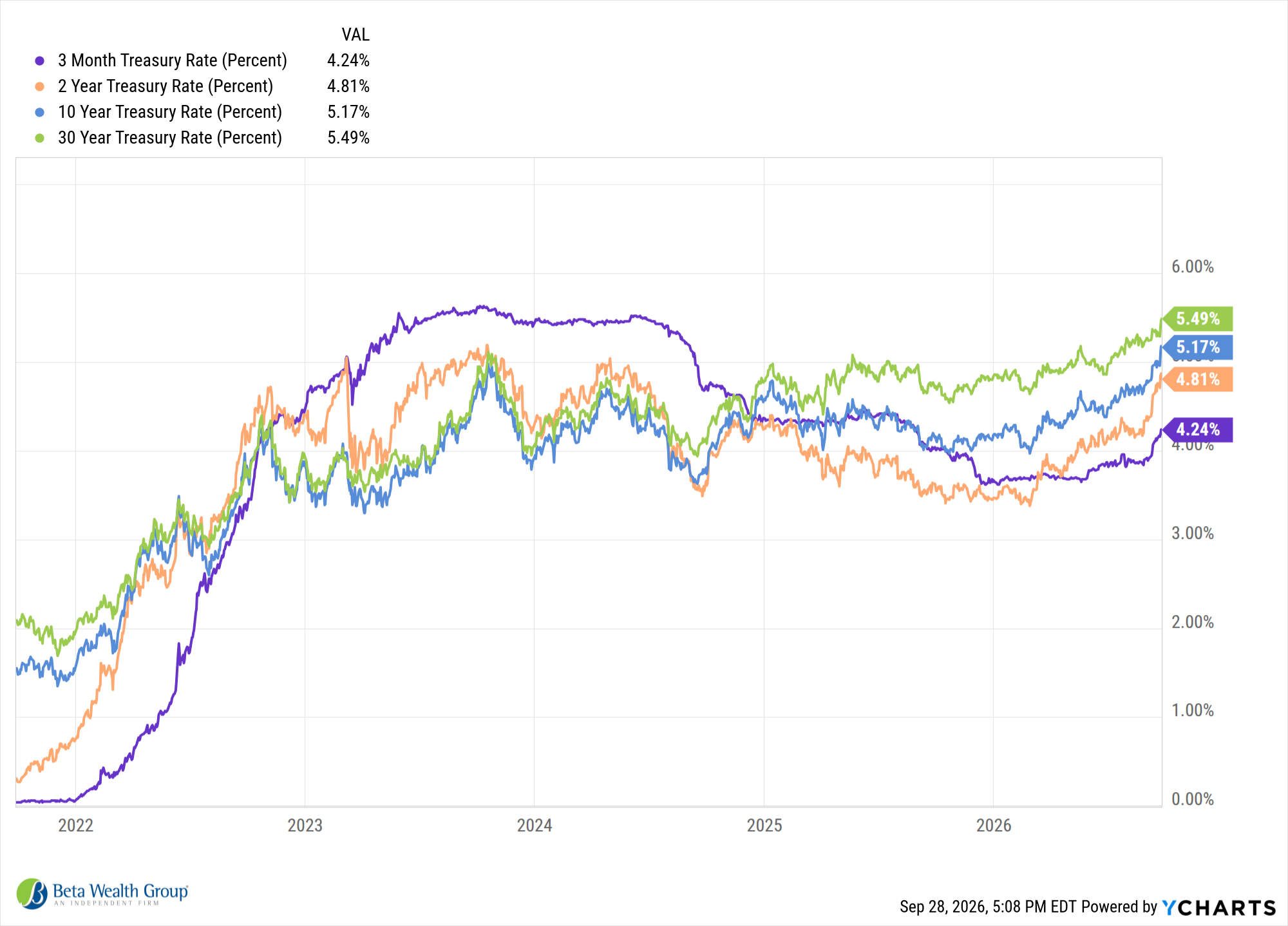
Global markets absorbed a major repricing of interest-rate expectations last week with notable resilience. Following the Federal Reserve’s first rate hike since July 2023, Treasury yields surged: the 10-year briefly topped 5%, its highest intraday level since 2007, while the 2-year ended at 4.74%. Futures markets now anticipate policy rates peaking near 4.75%–5.00% by mid-year, roughly 100 basis points above the current range.
Despite this bond-market selloff, risk appetite held up better than expected. The S&P 500 was essentially unchanged for the week and remains close to record territory, while the Nasdaq 100 reached new highs. Japanese equities outperformed supported by renewed AI enthusiasm and a weaker yen. By contrast, rate-sensitive sectors - including utilities, financials, real estate, and small caps - came under pressure.
The macro backdrop remains complicated: inflation is still elevated, activity data remains firm, and PMI and retail-sales results reinforced the case for a resilient U.S. economy. The dollar index rose 1.11% as wider yield differentials supported demand for U.S. assets, while Bitcoin also held up relatively well despite higher real yields.
Energy markets were volatile amid supply disruptions and shifting expectations around Middle East diplomacy. WTI finished near $100 per barrel, while Brent ended around $104. Refining margins moderated as diesel and gasoline prices eased from elevated levels.
This week, attention shifts to two critical U.S. data releases: Wednesday’s PCE inflation report and Friday’s employment report. A hotter PCE reading could validate the recent move in yields and reinforce expectations for additional Fed tightening. Conversely, softer inflation, or unexpected labor-market weakness, could challenge the market’s increasingly hawkish terminal-rate assumptions.
The central question: can equities continue to withstand higher-for-longer rates if inflation proves sticky?
The information above has been obtained from sources considered reliable, but no representation is made as to its completeness, accuracy or timeliness. All information and opinions expressed are subject to change without notice. Information provided in this report is not intended to be, and should not be construed as, investment, legal or tax advice; and does not constitute an offer, or a solicitation of any offer, to buy or sell any security, investment or other product.