
Market Update: October 26, 2026
o For illustrative purposes only. The graphic depicts a general investment approach and is not intended as personalized investment advice. Asset allocation and model selection will vary based on each client's objectives, risk tolerance, financial circumstances, and investment time horizon.
Global markets diverged last week as AI investment concerns, rising energy prices and persistent inflation shaped investor sentiment.
Equities: US stocks declined as elevated rates raised questions about AI investment sustainability and competition from open-source Chinese models intensified. The S&P 500 fell 1.94%. Europe’s STOXX 600 gained 2.13%, supported by easing yields, solid earnings and less AI exposure. South Korea’s KOSPI dropped 11.22% amid semiconductor weakness, but remained up over 30% year to date.
Fixed income: Safe-haven demand outweighed hotter inflation readings, pushing Treasury yields lower. The two-year and 10-year yields closed at 4.73% and 5.09%, respectively. US high-yield spreads widened 13 basis points to 321 basis points; investment-grade spreads increased just two basis points to 83.
Commodities and currencies: Middle East tensions and a larger-than-expected US inventory draw lifted oil despite an expedited emergency reserve release. WTI finished at $101.50/barrel and Brent at $109.72. Gold edged lower to $4,159.82/oz, while the dollar index declined 0.37%.
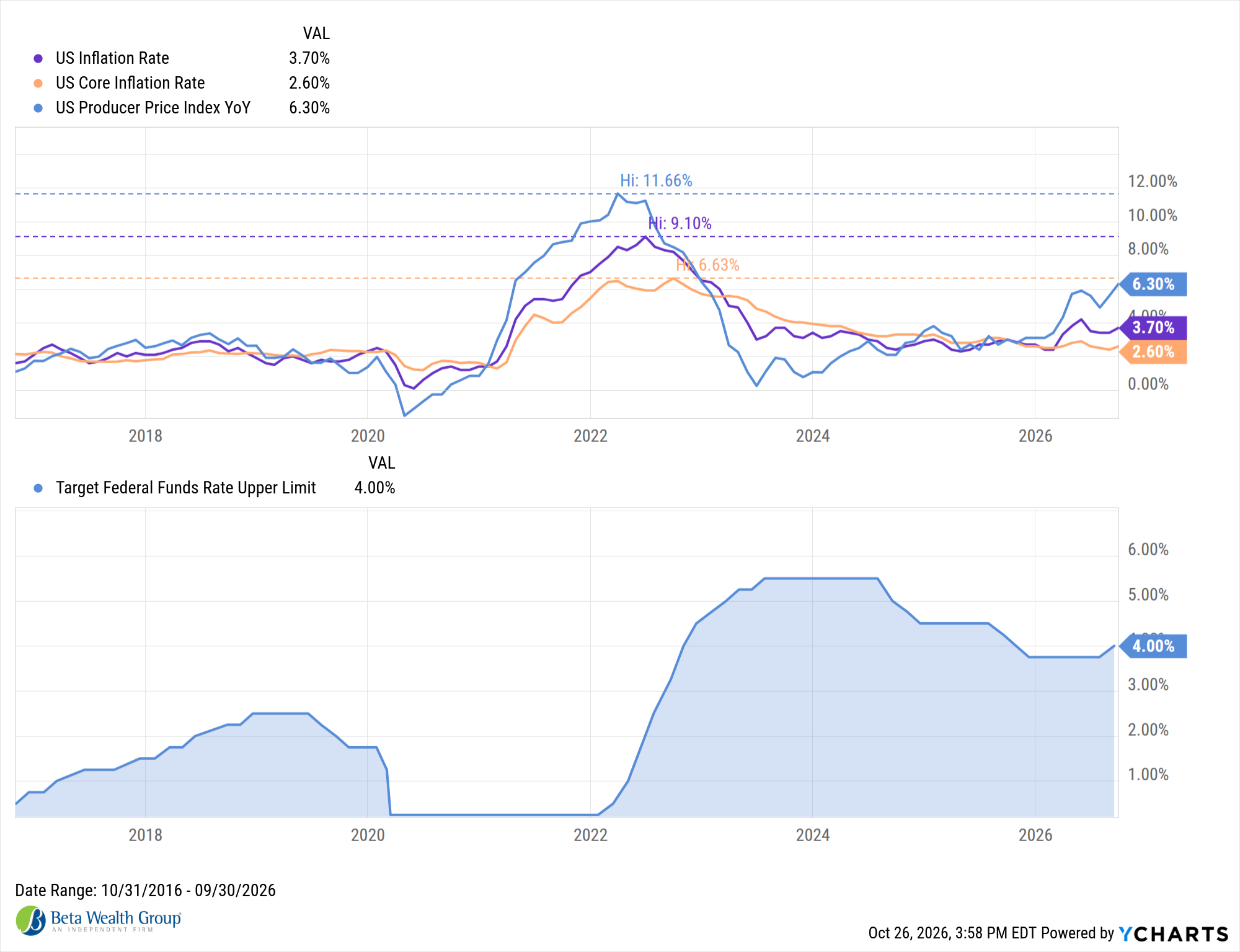
Inflation and policy: US headline CPI accelerated to 3.7% year over year, core CPI reached 2.6%, and PPI rose 6.3%, all above expectations. Energy remained a key driver. Markets now price two Fed hikes by March; our outlook remains a 25-basis-point December hike, followed by a pause until September 2027. China’s consumer inflation stayed subdued at 0.9%, while producer inflation accelerated to 5.0%.
Economic resilience: US retail sales increased 0.8%, although sales excluding gasoline rose just 0.2%. Industrial production gained 0.7%, and initial jobless claims remained low at 199,000.
The takeaway: Resilient activity and energy-driven inflation are complicating the policy outlook, even as equity volatility supports demand for bonds.
The information above has been obtained from sources considered reliable, but no representation is made as to its completeness, accuracy or timeliness. All information and opinions expressed are subject to change without notice. Information provided in this report is not intended to be, and should not be construed as, investment, legal or tax advice; and does not constitute an offer, or a solicitation of any offer, to buy or sell any security, investment or other product.